
In August 2022, when President Biden signed the CHIPS and Science Act, the narrative in Washington was highly unified: U.S. semiconductor manufacturing capacity had plummeted from 40% in 1990 to 12% in 2020, and policymakers needed to bring that capacity back. Four years later, what kind of report card has this industrial stimulus plan delivered?
Where Did the Money Go? According to supply chain analysis firm SupplyICs, the $39 billion earmarked for manufacturing subsidies has been fully committed, with subsidy awards extended to 23 recipients. Approximately $11 billion has been disbursed based on milestones, and the remaining committed funds will be disbursed as each project sequentially achieves agreed-upon milestones by 2028.
As of May 2026, three logic fabs funded by the CHIPS Act have entered mass production: TSMC (Taiwan Semiconductor Manufacturing Company) Fab 21 Phase 1 in Phoenix, Arizona (4nm, 24,000 wafers per month capacity), Intel's Module 1 in New Albany, Ohio (18A, 30,000 wafers per month capacity), and Samsung's Fab 1 in Taylor, Texas (3nm GAA, 15,000 wafers per month capacity). Additionally, 12 other funded fab projects are under construction, with mass production start dates ranging from late 2026 to 2029.
The major fab projects funded by the CHIPS Act and their current status are shown in the table below:
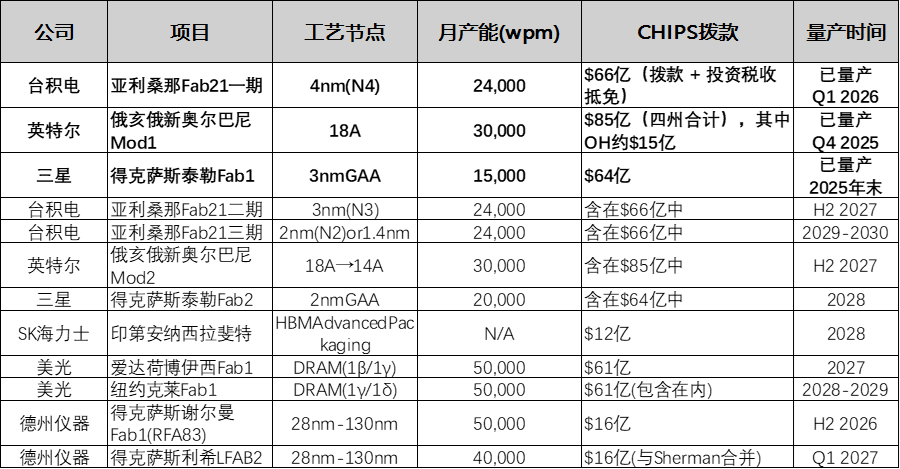
Data Source: SupplyICs Looking solely at the numbers, the Act seems to be delivering on its promises. But looking at the details, the situation is far more complex than the three words "in production."
Intel: The Biggest Beneficiary with the Heaviest Burden Intel received the largest single subsidy: $8.5 billion. The funding supports two 18A advanced fabs in Ohio. Module 1 entered production in Q4 2025 with a monthly capacity of 30,000 wafers. It will manufacture Panther Lake client CPUs and Clearwater Forest server chips, and also serve foundry customers Amazon (Trainium 3 AI accelerator) and Microsoft.
The 18A process (RibbonFET + PowerVia, i.e., GAA transistors + backside power delivery) is Intel's most competitive advanced node in its history, technically narrowing the gap with TSMC.
The bad news is that there are not enough external foundry customers. Beyond Amazon and Microsoft, there are almost no publicly announced large-scale foundry orders. Intel Foundry's revenue for the Q1 2026 fiscal quarter remained at only $4.4 billion, a year-over-year increase of 8%. For the new CEO Lip-Bu Tan, the real test is not whether the process works, but whether customers are willing to shift their designs from TSMC to Intel.
Moreover, Ohio's Module 2 has already been delayed to the second half of 2027 due to financial pressure. Intel previously canceled its fab construction plans in Germany and Poland, laid off 15% of its workforce, and its foundry business remains unprofitable to date. Against this financial backdrop, the $8.5 billion subsidy looks more like a hemostatic agent than a stimulant.
TSMC Arizona: The Best Report Card, but at a Huge Cost If the CHIPS Act has a star project, it is undoubtedly TSMC Arizona.
A $6.6 billion subsidy has leveraged a mega-project with a total investment of $165 billion. The site spans over 2,000 acres, planning for 12 fabs plus 4 advanced packaging facilities. The first 4nm fab commenced mass production in Q1 2026, with customers Apple and NVIDIA. NVIDIA Blackwell AI processors are now being manufactured on U.S. soil, marking the first time in TSMC's history that cutting-edge AI chips are produced outside of Taiwan.
Construction of the second 3nm fab has been accelerated, with equipment move-in scheduled for Q3 2026, a year ahead of the original plan. CoWoS advanced packaging facilities are also advancing, which will complete the full U.S. supply chain for AI chips from wafer to packaging.
But the costs are equally on the table: the construction cost of the first fab is 30-50% higher than that of equivalent capacity in Taiwan, operating costs are 30-40% higher, and chip manufacturing costs are 20-30% higher. The reason TSMC is willing to continue pouring money into expansion is largely not because U.S. costs are cost-effective, but because geopolitics has bought a "capacity insurance" policy, placing a portion of advanced manufacturing in the U.S. to alleviate customers' anxieties about supply chain concentration.
Samsung Texas: Substantial Subsidies, but Lagging Progress Samsung's first 3nm GAA fab in Taylor, Texas, received a $6.4 billion subsidy and began ramping up in late 2025, with a monthly capacity of only 15,000 wafers, the lowest among the three fabs in production.
The core issue is yield. As the world's only mass-produced Gate-All-Around (GAA) transistor architecture, Samsung has encountered severe yield challenges on both 2nm and 3nm nodes. Reports indicate that the GAA yield once dropped below 20%. Equipment deliveries have also been delayed as a result: due to insufficient customer orders, ASML has postponed the delivery of EUV (Extreme Ultraviolet) lithography machines. For machines costing $150–$200 million each, no one will place an order without orders to back it up.
A greater constraint comes from the guardrail provisions of the Act itself: companies accepting subsidies are prohibited from expanding capacity below 14nm in China for ten years. For a globally operated chipmaker like Samsung, the Chinese market is another core source of revenue besides the U.S. market. Restrictions on capacity expansion in China mean that the subsidy received is a check with implicit costs.
Micron, Texas Instruments, and SK Hynix: The Remaining Battlefield Micron, the only memory manufacturer in the U.S., received $6.1 billion, aiming to challenge the 90% monopoly share of South Korea's SK Hynix and Samsung in the HBM (High Bandwidth Memory) sector. However, it entered the HBM market relatively late, only strategically shifting to the HBM route in 2018, and then skipped HBM3 to bet directly on HBM3e. The strategy is forward-looking, but the technological gap will not be bridged in a short time. The two new fabs in Boise and Clay will not commence production until 2027 and 2028-2029, respectively.
Texas Instruments received $1.6 billion to build mature node fabs in Sherman, Texas, and Lehi, Utah. Although 28nm-130nm embedded chips are not "advanced" enough, it was precisely this type of chip that triggered the chip shortage during the pandemic; they are the lifeblood of automobiles, home appliances, and industrial equipment.
SK Hynix's $1.2 billion is invested in an HBM advanced packaging facility in Indiana, which will not commence production until 2028. This marks the first time South Korean semiconductor packaging capacity has landed in the U.S., carrying greater strategic than production-volume significance.
The Biggest Variable: Trump's "Equity for Subsidies" In mid-2025, the CHIPS Act encountered a major shift in policy direction.
Howard Lutnick, Secretary of Commerce in the Trump administration, proposed a radical plan: converting subsidies already committed to companies into government equity. The first target is Intel, with the government planning to hold an approximate 10% stake in Intel, turning "free money" into "equity dividends." The White House Press Secretary publicly called this an "unprecedented idea."
After the news broke, TSMC internally reportedly discussed the option of "directly returning the subsidies if required to accept government equity." Samsung and Micron remained silent, but the pressure was self-evident. Ultimately, the Department of Commerce signaled that it had "no intention of acquiring equity in TSMC and Micron," but hinted that "companies that have not increased their investment commitments may need to exchange equity for subsidies." This ambiguous strategy in itself is a form of pressure.
TSMC ultimately avoided being required to give up equity by proactively expanding its investment scale, increasing it to $165 billion. But this victory was exchanged for huge financial costs.
Another cancellation was the $7.4 billion R&D subsidy for the National Semiconductor Technology Center (NSTC). This dramatic shift has brought new uncertainty to the grand plan aimed at revitalizing the domestic semiconductor industry in the U.S.
The Inescapable Truth About Costs The CHIPS Act can subsidize capital expenditures, but it cannot subsidize operating expenses.
A mid-2026 assessment by supply chain analysis firm SupplyICs provides a clear cost comparison:
In other words, the CHIPS Act has made building fabs in the U.S. feasible, but not cost-effective. The budget for TSMC Arizona's first fab is $12 billion, while equivalent capacity in Taiwan would only cost $5–$7 billion. Who will pay the extra money? It will ultimately be passed on to the price of every single wafer.
Engineer salaries account for the other half of the cost gap. Process engineers in the U.S. earn an annual salary of $120,000 to $150,000. In addition, consumables such as ultra-pure water, specialty gases, and chemicals still need to be transported from Asia, compounding logistics costs.
So, What Is the Result? Looking at the four-year performance of the CHIPS Act through a few hard metrics: Has capacity returned? According to estimates by the Semiconductor Industry Association, the global share of U.S. advanced logic manufacturing has risen from about 12% in 2020 to about 22% in 2026. The increase in capacity is tangible.
Has supply chain security been resolved? No. The combined monthly capacity of the three fabs in production is only 69,000 wafers, which is just a fraction of a single TSMC fab in Taiwan. It is still a long way from true supply security.
Have costs come down? No. Manufacturing an advanced wafer in the U.S. is 20-30% more expensive than in Taiwan. This is a structural gap that cannot be erased by subsidies.
Has policy stabilized? No. The controversy over "equity for subsidies," the cancellation of R&D subsidies, and the fundamental bipartisan disagreement on the execution logic of the Act have left the entire policy framework in continuous uncertainty. What enterprises fear most is not high costs, but rules that are constantly changing.
For the chip industry, however, there is only one most certain trend: dual sourcing has become the new default configuration. U.S. capacity will never completely replace Asian capacity, but it is becoming an expensive, irreplaceable second leg.