
In the first half of the AI era, the industry's focus has been on the training and inference of large models in the cloud; in the second half, it will inevitably shift towards scenario implementation and practical applications. In May 2026, Jensen Huang outlined a clear AI development roadmap during an interview with Bloomberg: The first stage is cloud AI, which is the stage we are currently in, where various large models are deployed and run in data centers; The second stage is personal AI. In the future, computers and smartphones will have built-in local pre-trained models. AI will be able to understand your usage habits based on current operational scenarios, providing close assistance in work and life. Dell has already achieved the pre-installation of local models on AI PCs, while Qualcomm and Apple are also going all out to deploy AI smartphones; The third stage is physical AI. AI will be able to comprehend the physical rules of the real world and be widely applied in heavy industry, factory production lines, autonomous driving, and various robotics fields. This is the next wave that will disrupt global productivity. So, in this massive migration of computing power from the cloud to the edge, how far have Chinese chip companies progressed?
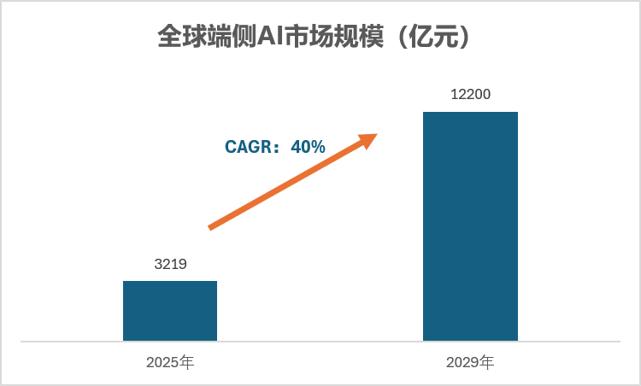
The Inflection Point of the On-Device AI Industry Has Arrived Compared to relying entirely on cloud AI, on-device AI inherently possesses numerous advantages such as privacy and security, offline availability, zero network latency, and low usage costs. Since the second half of 2025, policies supporting the development of on-device AI have been released intensively. In August 2025, the State Council set quantitative targets in the "Opinions on Deepening the Implementation of the 'AI+' Action": by 2027, the penetration rate of new-generation intelligent terminals will exceed 70%; In January 2026, the Ministry of Industry and Information Technology (MIIT) and seven other departments jointly issued the "Implementation Opinions on the Special Action of 'AI + Manufacturing'", explicitly supporting breakthroughs in on-device inference chips; In March 2026, the "Report on the Work of the Government" proposed accelerating the promotion of new-generation intelligent terminals and intelligent agents, centering on "building a new form of intelligent economy". Meanwhile, at the local level, cities such as Shenzhen, Suzhou, and Hefei have successively introduced purchase subsidy policies for on-device AI terminals. On-device AI has evolved from an industry consensus to a national action. According to Frost & Sullivan, the global on-device AI market size is expected to leap from 321.9 billion RMB in 2025 to 1.22 trillion RMB in 2029, with a compound annual growth rate of approximately 40%.
Layout of Domestic Chip Manufacturers in On-Device AI As computing power moves from data centers to endpoint devices, the competitive logic of chips has also changed: it is no longer about who has the higher peak computing power, but who can find the optimal solution among power consumption, latency, ecosystem compatibility, and safety & reliability. In the industrial trend of on-device AI, domestic chip manufacturers are building differentiated on-device AI landscapes based on their respective technological accumulations.
Rockchip: The "Dual-Track" Route of SoC + Coprocessor Rockchip has chosen a "dual-track" route of "SoC + coprocessor" in the on-device AI track, where the SoC handles system scheduling and traditional computing, while the coprocessor focuses on large model inference. This clear division of labor and efficient collaboration avoids the awkwardness of a single chip being "a jack of all trades but master of none". Its flagship SoC chip, the RK3588, adopts an 8nm process and features a built-in 6 TOPS NPU. It has achieved large-scale shipments in fields such as robotics, intelligent cockpits, and industrial vision. Multiple intelligent terminal products from manufacturers like Unitree Robotics, Agibot, and Ecovacs adopt this chip. In May 2026, Rockchip launched the RK3572 octa-core processor targeting the mid-tier AIoT market, achieving a breakthrough balance between high performance, low power consumption, and full-stack AI capabilities. The RK3572 adopts an advanced 8nm process and integrates an octa-core architecture with dual Cortex-A73 big cores and six Cortex-A53 little cores. It features a built-in 4 TOPS NPU, delivering powerful on-device AI computing power. The real hidden weapon is the RK182X AI coprocessor. This chip, the world's first to feature a 3D stacking architecture, directly integrates high-performance memory onto the NPU, possessing outstanding computing power and bandwidth capabilities. In terms of visual perception: It fully supports mainstream CNN/ViT models, expanding from traditional object detection to semantic understanding and multi-modal association capabilities, providing high-precision, low-latency object detection, recognition, and perception capabilities for industrial vision, security monitoring, and robot navigation; In terms of text models: It efficiently runs mainstream large language models including Qwen and DeepSeek, enabling intelligent terminals to have smooth dialogue, logical reasoning, and content generation capabilities. Based on actual test data, the output speed of Rockchip RK182X running the Qwen2.5-3B model has broken the 100-token barrier; In terms of multi-modal deployment: It has completed the on-device deployment optimization for multi-modal large models such as Qwen3-VL-2B/4B, enabling devices to understand both images and text simultaneously, and realizing complex tasks such as visual question answering, image captioning, and document analysis. The output speed of RK182X running the Qwen3-VL-2B model reaches 136.32 TPS, and the output speed running the Qwen3-VL-4B model is nearly 100 tokens. On March 9, 2026, Rockchip officially released the RKNN3 SDK V1.0.0 for the RK1820/RK1828 AI coprocessors, providing full-stack software support for on-device AI model deployment. Notably, at Rockchip's first AI Software Ecosystem Conference, the upgraded AI coprocessor RK1860 was also announced. It is expected to undergo internal engineering sample testing in Q2 2026. It features stronger computing power of 64 TOPS (dense computing power); larger memory options of 2.5GB/5GB/10GB, expandable with LPDDR; and supports larger models, ranging from 3B to 13B parameters.
Horizon Robotics: From Autonomous Driving Chips to Whole-Vehicle Intelligent Agents If Rockchip is the benchmark for consumer and industrial-grade on-device AI, then Horizon Robotics is the most hardcore player in the intelligent vehicle AI track. From Journey 2 to Journey 6P, Horizon Robotics has completed the leap of domestic autonomous driving chips from being "hesitant to use" to "eager to adopt" in ten years. The Journey family has achieved cumulative shipments of over 10 million units, with partnerships covering all top 10 domestic automakers, over 40 brands, and more than 400 launched vehicle models, cumulatively serving over 6 million car owners. This chip company, once questioned as "unable to do it", has become the first autonomous driving technology brand in China to break through the 10-million-level mass production. In April 2026, Horizon Robotics released "Starry 6P", China's first cabin-driving fusion whole-vehicle intelligent agent chip, integrating the computing of the four domains of autonomous driving, cockpit, instrument cluster, and vehicle control into a single 5nm chip. This architecture reduces the cost of the domain controller per vehicle by 1,500 to 4,000 RMB. The Starry 6P boasts a peak AI computing power of 650 TOPS, a maximum bandwidth of 273 GB/s, and integrates a 20-core CPU (500K DMIPS). According to on-site information from the launch event, in Q1 2026, the Starry 6 series had completed real-vehicle validation and is expected to be officially mass-produced and installed in vehicles in Q3 this year. Manufacturers such as BYD, BAIC Group, Chery Automobile, and Changan Automobile will be among the first to adopt it. Notably, in recent years, autonomous driving chip manufacturers have flocked to expand into the robotics industry. Horizon Robotics' associate company, D-Robotics, launched the S600, a high-computing-power development platform for embodied intelligent robots, in the first quarter of 2026. With 560 TOPS of computing power, it adopts an efficient and flexible "big brain and little brain" architecture design and has been deeply optimized. Its "big brain" is equipped with an 18-core A78AE CPU and the new BPU Nash, supporting the efficient on-device deployment of various embodied large model algorithms such as VLA, VLM, LLM, and Locomotion; the "little brain" is configured with a 6-core R52+ MCU, specifically optimized for humanoid robots, possessing highly reliable and real-time motion control capabilities.
Black Sesame Technologies: Empowered by Jiushao NPU, Computing Power Surpasses Thor-U In the direction of intelligent vehicle applications, Black Sesame Technologies and Horizon Robotics are the two benchmark computing chip manufacturers in China. In April 2026, at the Beijing Auto Show, Shan Jizhang, Founder and CEO of Black Sesame Technologies, officially released the new lineup of the Huashan A2000 family: A2000N (200 TOPS), A2000L (400 TOPS), A2000U (700 TOPS), and the flagship A2000X (1000 TOPS). The four chips cover the complete demand gradient from cockpit AI Box, multi-sensor fusion urban NOA, new AI paradigm ADAS, to L3 and Robotaxi. This marks the first time that domestic autonomous driving chips have surpassed NVIDIA's Thor-U (700 TOPS) in the pure dimension of computing power. From the very beginning of its design, the entire A2000 family has been oriented towards the efficient deployment of VLA models and world models, natively supporting large-scale Transformer acceleration, and comprehensively supporting new paradigm-oriented ADAS systems. The core competitiveness of the A2000 family lies in its self-developed "Jiushao NPU" architecture, which adopts a physical UniqueAI computing design, eliminating the synchronization overhead of traditional multi-core architectures and supporting INT4 to FP32 mixed-precision computing across the entire pipeline. More crucially, FP16 models can run directly without quantization, avoiding precision loss. This means developers do not need to invest extra model compression costs for chip adaptation, significantly lowering the threshold for on-device deployment. At the mass production level, Black Sesame Technologies has reached a cooperation with iSMART and obtained the first project nomination for the mass production solution of the Huashan A2000 chip, covering full-scenario autonomous driving functions from L2+ to L3. The first batch of mass-produced vehicles equipped with it is expected to roll off the production line within 2026. Notably, the A2000 passed the 11-month export control review by the Bureau of Industry and Security (BIS) of the U.S. Department of Commerce in January 2026, becoming the first domestic automotive-grade chip company to pass such a review. It is worth pointing out that Black Sesame Technologies has also extended its business footprint from automobiles to the robotics field. At the end of 2025, the company launched three standardized computing power modules for the SesameX platform, with computing power covering 69-600 TOPS, transplanting automotive-grade safety standards to ensure stable equipment operation. In the first quarter of 2026, it completed the acquisition of Zhuhai Yizhi, supplementing its low-power chip capabilities. The entry-level modules are adapted for household sweeping and mowing robots; the mid-range modules are supplied in batches for quadruped equipment used in ship and power grid inspection, as well as outdoor wheeled-legged companion robots; the high-end modules are supplied to humanoid robot manufacturers for prototype debugging. In June 2026, its embodied intelligence business headquarters officially settled in the "Shengang Hui" base in Qianhai, Shenzhen.
Moore Threads: From GPU to "Changjiang" Intelligent SoC If the first three are native on-device AI players, then Moore Threads has crossed over into the "cloud-edge-end" from the very beginning. In May 2026, at the Mobile World Congress Shanghai, Moore Threads showcased its diverse products and solutions from intelligent computing clusters to endpoint devices, covering the full scenarios of "cloud, edge, and end", systematically presenting the company's technological breakthroughs in large model training and inference, scientific computing, on-device intelligence, and embodied intelligence. In terms of cloud intelligent computing, Moore Threads showcased the MTT S5000, an AI training and inference integrated intelligent computing card specifically designed for large model training, inference, and high-performance computing, supporting full-precision computing from FP8 to FP64; In terms of edge and endpoint intelligent computing, with its self-developed intelligent SoC "Changjiang" as the core, Moore Threads exhibited the edge AI module MTT E300, the AI computing laptop MTT AIBOOK, and the home AI hub MTT AICUBE. The MTT E300 (industrial edge AI module) supports wide-temperature operation from -20°C to +65°C and is specifically designed for industrial sites; the MTT AIBOOK can support up to 12 agents running in parallel on a single machine, with a native Linux system pre-installed with the MTClaw agent framework; the MTT AICUBE, serving as a home AI hub, is equipped with the omni-domain agent "Xiaomai", integrating over 90 system tools and more than 60 skills, covering full scenarios from homework tutoring to home NAS. Moore Threads' self-developed "Changjiang" intelligent SoC chip internally integrates a CPU, a full-featured GPU, an NPU, and a VPU, with heterogeneous AI computing power reaching 50 TOPS, supporting INT8 to FP64 multi-precision mixed computing. The benchmark for this chip is not NVIDIA, but rather Qualcomm, MediaTek, and even Intel's Core. "Changjiang" uses a single SoC to simultaneously solve all needs for general-purpose computing, AI inference, graphics rendering, and video encoding and decoding. Notably, Moore Threads is leveraging the unified MUSA architecture to achieve cloud-end collaboration between the 10,000-card cluster in the cloud and the "Changjiang" SoC at the end. The endpoint handles real-time response, while the cloud handles complex training. The pattern of "walking on two legs" has taken shape.
Hygon Information: From Cloud Downward, Closing the Loop of the "Cloud-Edge-End" System Hygon Information represents another path, which is the systematic extension from a cloud computing power giant to the endpoint. In July 2026, at the OpenArchi Intelligent Computing Application Conference, Hygon for the first time centrally presented the complete "cloud-edge-end" computing power system with CPU and DCU as the dual-chip foundation. This system uses the CPU for global scheduling, the DCU to accelerate intelligent computing, and embedded chips to connect the industrial field. Based on these three pillars, it maintains full-link trustworthiness with intrinsic security, forming a complete computing power landscape from data centers to industrial sites. At the endpoint, Hygon holds three key advantages. The first is C86 compatibility, natively compatible with the x86 ecosystem. Industrial software, configuration tools, and business systems can run natively, making project migration almost zero-cost, which is the optimal solution for replacing traditional industrial control computers. The second is intrinsic security, supporting national cryptographic algorithms, trusted computing, and privacy computing from the underlying architecture. Without the need for external security devices, it achieves "chip-root-to-end" native security capabilities, which is a rigid demand for key industries such as industrial control, finance, and energy. The third is ecosystem scale. Relying on the OpenArchi organization to gather over 6,000 ecosystem partners, the DCU has been adapted to mainstream large models such as GLM, DeepSeek, MiniMax, and Kimi, covering 99% of non-closed-source large models globally. At the conference, Hygon showcased multiple application achievements such as intelligent inspection robots, AI BOX endpoint all-in-one machines, and closed-scenario industrial autonomous driving solutions, covering typical scenarios such as industrial control, endpoint physical AI inference, and intelligent equipment. Relying on Hygon's C86 chip-level intrinsic security capabilities, related solutions can better meet the needs of key industries such as finance, robotics, low-altitude economy, zero-carbon, oil and gas, industry, energy, and transportation for data security, stable operation, and trusted computing.
Conclusion On-device AI is not a mere appendage to the cloud, but the last mile for AI to truly become a productive force. Chinese manufacturers possess unique advantages in the on-device track: massive application scenarios, a complete supply chain system, and the ability to turn high-tech into "high cost-performance". Only when computing power moves from data centers to thousands of industries and millions of households can AI be considered to have truly completed the comprehensive upgrade from technology to productive force.