
After the initial listing application materials expired, Wuxi Nexyad Intelligent Technology Co., Ltd. (hereinafter referred to as "Nexyad"), a technology company in the intelligent cockpit sector, recently submitted its listing application to the Hong Kong Stock Exchange again. On the eve of its initial listing application submission, multiple shareholders of Nexyad made sudden equity transfers. On the same day, a significant price difference emerged between the transfer of old shares and the capital increase, raising regulatory concerns over the rationality of the pricing and the potential existence of tunneling.
Securities Star noted that Nexyad's fundamentals hide multiple concerns. Over 80% of the company's revenue relies on the SA8155 domain controller, but the selling price of the core product has declined year by year, dragging down the company's overall gross profit margin. Although the commercialization of new products has been initiated, it is far from providing effective support. The company's losses continue to intensify, with a cumulative loss of approximately RMB 1.03 billion from 2023 to 2025 (hereinafter referred to as the "Reporting Period"), and its cash flow continues to "bleed". In addition, Nexyad's customers and suppliers are highly concentrated, with the top five customers contributing over 90% of revenue, while the largest supplier, Bosch, not only accounts for a significant share of core material procurement but also holds a 3.63% stake in the company.
01. Share Reduction and Capital Increase on the Same Day, Price Difference Attracts Regulatory Attention
The prospectus shows that Nexyad was established in August 2014. After completing a RMB 35 million Series A financing in 2016, it embarked on an intensive financing process. As of November 27, 2025, Nexyad has completed 14 rounds of financing, with a total cumulative financing amount of approximately RMB 1.865 billion. Investors include Weifu High-Technology, Beijing Siwei, Cornerstone Fund, Weilian Investment, and local state-owned capital.
As early as November 2025, Nexyad had submitted its initial listing application to the Hong Kong Stock Exchange. However, on the day before the disclosure of the IPO draft, some shareholders of the company made sudden share reductions. On November 27, 2025, NIO New Energy transferred approximately 230,000 shares to Anpeng Automotive for RMB 25 million and approximately 471,800 shares to Wuxi Shangwen for RMB 50 million. The transfer prices were approximately RMB 108.69/share and RMB 105.97/share, respectively. On the same day, NIO New Energy transferred 2.335 million shares to its affiliate, Weilian Investment, for RMB 123 million. Following this transaction, NIO New Energy’s direct shareholding fell to zero, and Weilian Investment took a 6.94% stake.
NIO New Energy is an old shareholder of the company. It acquired shares via an equity transfer in May 2017, purchasing registered capital of RMB 646,000 at a total consideration of RMB 16.15 million, at a transfer price of RMB 25/share. In the Series B financing round in December 2017, NIO New Energy subscribed for registered capital of RMB 2.4932 million with a total subscription consideration of RMB 149 million, once leaping to become the second-largest shareholder with a shareholding ratio of 18.52%.
On the same day as NIO New Energy's share reduction, Qin Lihong, one of the founders of NIO, transferred 138,000 shares to Sichuan Bihong for RMB 15.0014 million; Wu Yeheng transferred 46,000 shares to Sichuan Bihong for a total consideration of RMB 4.9986 million, and transferred 184,000 shares to Kaizhilian for RMB 20 million. The aforementioned transfer prices were approximately RMB 108.69/share.
Securities Star noted that in the Series PI financing on the same day, Nexyad issued a total of RMB 4.1954 million of registered capital subscribed by 7 investors including Wuxi Shangwen, Wuxi High-Quality Fund, and Shenzhen Zhongxin Pengxiang, with a total transaction amount of RMB 570 million and a subscription price of approximately RMB 135.86/share.
On the same day, the issue price for the capital increase was RMB 27.17 to RMB 29.89 higher per share than the share transfer price. This pricing difference attracted focused regulatory attention during the company's initial Hong Kong IPO. In March 2026, the China Securities Regulatory Commission (CSRC) issued a supplementary material request to Nexyad, requiring it to explain the pricing basis for new shareholders’ entry prices over the prior 12 months, the reasons for the pricing difference with the capital increase during the same period and its rationality, as well as the tax payment situation, whether there are abnormal entry considerations, and to issue a clear conclusive opinion on whether there is tunneling.
02. Single Product Supports Over 80% of Revenue, Cash Flow Continues to "Bleed"
Nexyad is an important participant in the upgrade of domestic automotive electrical/electronic (E/E) architectures. The company's business consists of two interconnected product lines: vehicle computing solutions and zonal controller solutions. In 2021 and 2025, Nexyad successfully achieved the global debut and mass production of the intelligent cockpit domain controller based on the Qualcomm Snapdragon SA8155P platform and the cockpit-driving fusion domain controller based on the Qualcomm Snapdragon Ride Flex SA8775P.
As orders were gradually released, Nexyad's revenue in 2023 surged by over 500% year-on-year to RMB 2.298 billion. However, the revenue growth trend did not last long. In 2024 and 2025, the company's revenues were RMB 2.656 billion and RMB 2.065 billion, respectively, with a year-on-year decline of 22.23% in 2025.
By product segment, vehicle computing solutions accounted for all of the company’s revenue in 2023 and 2024. In 2025, Nexyad newly expanded its zonal controller business, generating an annual revenue of RMB 55.167 million, accounting for 2.7% of total revenue. The overall revenue is still mainly driven by vehicle computing solutions.
Further breaking down the vehicle computing solutions reveals that the company's revenue is highly concentrated in the SA8155 domain controller. During the Reporting Period, SA8155 domain controller revenues stood at RMB 2.284 billion, RMB 2.631 billion and RMB 1.705 billion, accounting for 99.4%, 99.1% and 82.5% of total revenue respectively, representing a 35.2% year-on-year drop in 2025. In the second half of 2025, Nexyad began to commercialize the SA8255 domain controller and the SA8775 controller, with their revenue shares in 2025 being 5.3% and 5.7%, respectively.
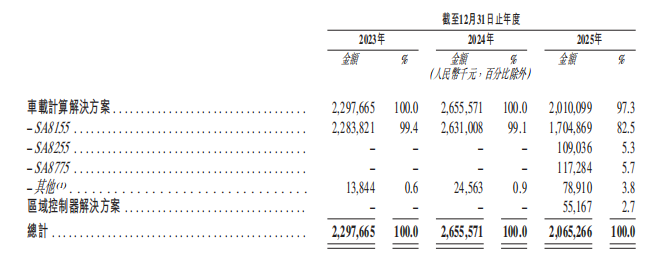
Securities Star noted that as more advanced SoCs (Systems on Chip) are introduced to the market and industry competition intensifies, the market pressure on the SA8155 domain controller has sharply increased. During the Reporting Period, sales volumes of this product fluctuated, hitting 623,800 units, 798,100 units and 563,100 units respectively, while the average selling price dropped all the way from RMB 3,661 in 2023 to RMB 3,028 in 2025.
Fierce industry competition continues to suppress the pricing of the SA8155 product. The product’s gross margin fell from 17.6% in 2023 to 16% in 2025, dragging Nexyad’s overall gross margin down from 17.5% to 15.5%.
While the profitability of core products is under pressure, Nexyad has also been trapped in losses. During the Reporting Period, the company recorded net losses of RMB 201 million, RMB 253 million and RMB 576 million respectively. The losses continued to intensify, with a cumulative loss of RMB 1.03 billion over the three years. The main reasons for the continuous losses are threefold: first, nearly all of its revenue came from the SA8155 domain controller; second, raw material procurement incurred substantial operating costs; third, product development and iteration drove heavy R&D spending.
Nexyad stated that it expects the net loss in 2026 to increase compared to 2025, mainly because the company is making significant investments in product iteration, and R&D expenses are increasing as it continuously updates and expands its product portfolio.
Due to continuous losses and large notes receivable, Nexyad's cash flow from operating activities during the Reporting Period was -RMB 697 million, -RMB 1.011 billion, and -RMB 872 million, respectively, remaining in a "bleeding" state.
03. Customer Concentration Exceeds 90%, Over 60% of Procurement Relies on a Single Supplier
At this stage, Nexyad has established long-term and stable cooperative relationships with leading domestic OEMs. As of the prospectus disclosure date, the company had secured design wins for 164 vehicle models and achieved mass production for 130 models.
However, high customer concentration has become a prominent feature of Nexyad's operations; the vast majority of its SA8155 domain controllers were sold to its top five customers. During the Reporting Period, revenue from the top five customers accounted for 99.5%, 98.7%, and 90.4% of total revenue, respectively. Among them, revenue from the largest customer was RMB 1.356 billion, RMB 1.557 billion, and RMB 631 million, accounting for 59%, 58.7%, and 30.6% of total revenue, respectively.
Nexyad expects sales to its top five customers will continue to make up a large portion of revenue, a trend mainly attributable to the inherent concentration of China’s downstream passenger vehicle OEM market.
The upstream supply chain of Nexyad also suffers from excessive concentration. During the Reporting Period, the company's procurement amount from the top five suppliers accounted for 89%, 85%, and 70.6% of total procurement, respectively. Among them, Bosch has steadily remained the largest supplier; its procurement from Bosch in each period totalled RMB 2.218 billion, RMB 2.019 billion and RMB 1.664 billion, accounting for 82.9%, 80.3%, and 62.4% of total procurement, respectively. The main content of Nexyad's procurement from Bosch is PCBA (Printed Circuit Board Assembly) and related services, and the cooperation between the two parties is mainly concentrated in the field of SA8155 and SA8255 domain controllers.
Securities Star learned that, as the product’s core component, PCBA accounted for more than 80% of total procurement value during the Reporting Period, and Nexyad mainly relies on overseas manufacturers such as Bosch for procurement. International suppliers usually have higher pricing power than domestic suppliers and can maintain higher prices.
Nexyad stated that due to the company's small revenue scale and weak bargaining power with international suppliers, operating costs remain at a high level. To improve this situation, in addition to independently developing PCBA with equivalent functions, Nexyad also plans to gradually transition its procurement from international suppliers to domestic Chinese suppliers.
Bosch and Nexyad have multiple layers of affiliated relationships. In addition to being the largest supplier, Bosch is also a shareholder of Nexyad with a 3.63% stake. Furthermore, Bosch held more than 5% of Weifu High-Technology’s shares. As Nexyad’s second-largest shareholder, Weifu High-Technology held an 8.13% stake in the company. (First published in Securities Star, Author | Lu Wenyan)
- End -