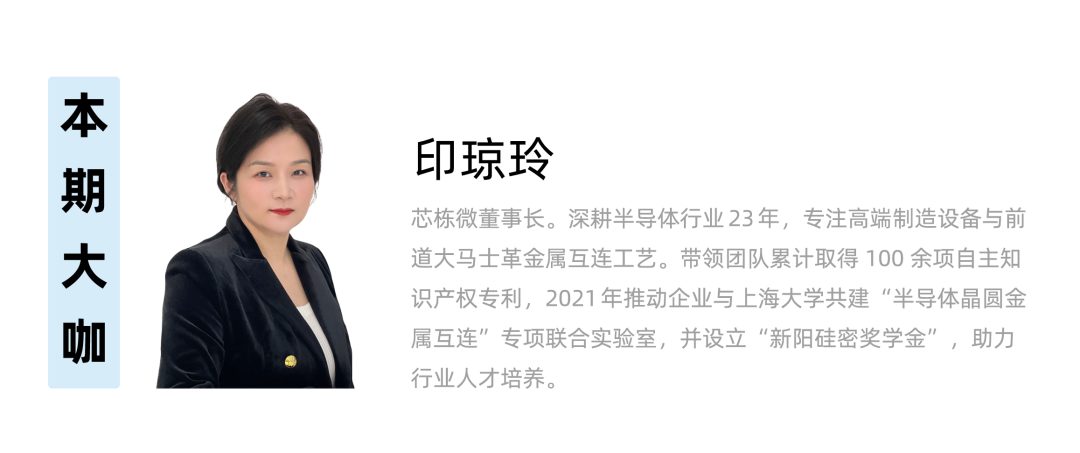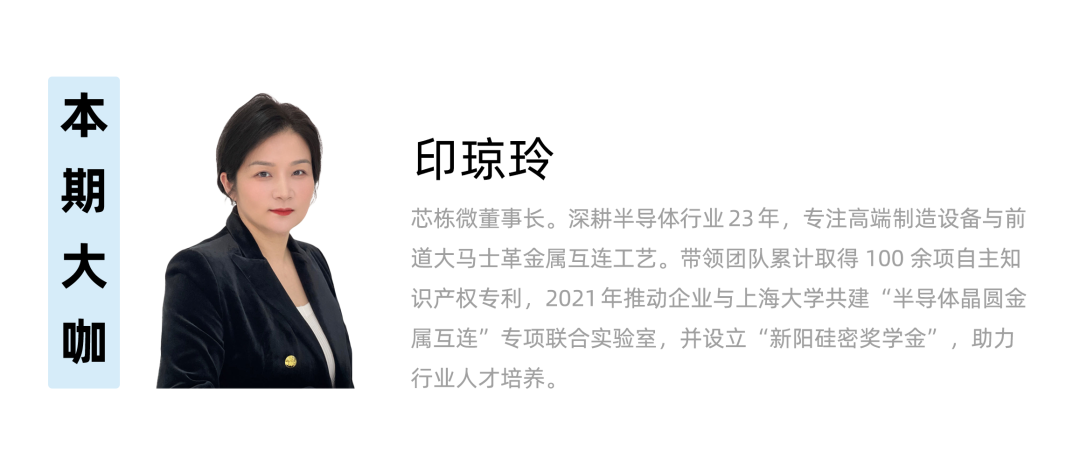
Editor's Note From CPUs to GPUs, from HBM to Chiplet, almost all high-performance chips are related to a metal interconnect process named "Damascene". It originates from the metal inlay wisdom of ancient Syrian craftsmen two thousand years ago: "etch trenches first, then fill with metal", enabling copper interconnects to be accurately realized at the nanoscale. Without it, Moore's Law might have stalled at 90nm. In this issue of "Chip Unveiled · Experts Talk Chips", we interview Yin Qiongling, Chairman of Xindongwei, who has been deeply engaged in the industry for two decades, to help you understand this chip manufacturing process with an extremely high technical threshold.
Welcome to the Podcast *The following is the text transcript of the podcast, confirmed and authorized by the guest.
Forging a New Path: From Microelectronics to Semiconductor ECD Equipment
Huan Shi: Ms. Yin, I see your major is microelectronics, which is strongly related to our semiconductor industry. I know many friends who studied microelectronics went into chip design. May I ask why you didn't choose chip design when founding Xindongwei, but directly challenged the electrochemical deposition (ECD/ECP) equipment, a "fortress" guarded by international giants? Did you see a specific market gap at that time, or was it based on a "must-do" technical obsession?
Electrochemical Deposition: English Electrochemical Deposition, abbreviated as ECD. High-frequency industry abbreviation: ECP (Electrochemical Plating).
Yin Qiongling: Yes, I majored in microelectronic materials. Many of my classmates and partners are in this industry. Actually, in the semiconductor industry, every position is important. It is a pragmatic industry where you can achieve results if you put in the time, and it requires a wide variety of talents.
My choice to do equipment was actually quite coincidental. At that time, most classmates chose to do processes directly related to materials, while I chose equipment. I didn't expect to be doing it for over twenty years. Today, I am still in this industry and can still serve semiconductor manufacturing or microelectronics design, which is quite lucky.
I think one must have a good mindset in this line of work and must adhere to long-termism. Because technology is always developing, every new generation of products requires new production technologies. Whether in the United States or the Asia-Pacific region, places where semiconductors develop well are all driven by market application scenarios to continuously advance equipment and materials, in such a cyclical process. Being part of it is a very happy thing.
Huan Shi: Those who persist are the kings. Especially since China's semiconductor industry has been developing at high speed. As a participant, you should have deep feelings. The industry has changed so much from its infancy when you first joined to today, where so many enterprises and audiences crowd the Jiufengshan Forum.
Yin Qiongling: Yes. I have been in this industry for many years and experienced several stages. Originally, our development was greatly affected by changes in the international market. Now it's different; the terminal market is in China—whether it's automobiles or various compound chips, we are closer to the demand. Driven by the domestic market, every industry is equally important, which gives practitioners across the industry a new opportunity. In the future, chips will definitely be the foundation and food of industry. We can only do our part, do our professional work well, and continue to work hard.
Huan Shi: Very pragmatic remarks. Back to Xindongwei's positioning: electroplating equipment. When I first heard the word "electroplating", it felt very traditional, thinking isn't that for surface processing? Could you tell us why you do electroplating? You are a veteran of 20 years; behind the direction you chose, there must be opportunities we can't see.
Yin Qiongling: Actually, it is still surface processing, except we do surface processing on silicon wafers. My choice to do electroplating was divided into two stages. My previous work experience mainly focused on wet process equipment, not specifically on electroplating. Later, I chose to cooperate with Shanghai Sinyang to take the lead in forming a special electroplating equipment team, which marked my official entry into the second stage.
The application of electronic electroplating in the semiconductor and pan-semiconductor fields is very extensive. As long as it involves metal interconnects and power connections, there are processes for depositing metals like copper, gold, nickel, and silver on the silicon wafer surface. We started focusing on electroplating equipment ten years ago, seeing the strong demand: new chips spawned by a large number of new applications all require better metal deposition technology. So we chose this track. This track itself also has its particularities; it requires solid hardware skills and is micro-nano processing for silicon wafer surface treatment.
Huan Shi: I shouldn't have mentioned "surface processing" earlier. Such a high-end technology was downplayed by me.
Yin Qiongling: But you are absolutely right; the basic principles of both are the same. It's just that the electrochemical principles at the micro-nano scale are still an industry "black box". Many processes have not fully understood the principles but have already been put into mass production. Therefore, in the early stage, a large number of customers were unwilling to replace our equipment or materials.
However, with the advancement of domestic substitution over the years, everyone's mindset has become much more open, welcoming domestic materials and equipment. But you can't pursue domestic substitution just for the sake of it; ultimately, you must create value for customers. To this end, we built our own dedicated electroplating laboratory, which is open to the outside, linking with various electroplating material manufacturers for collaborative R&D and mutual progress.
Huan Shi: Where is your laboratory platform built?
Yin Qiongling: In Lingang, Shanghai. If everyone wants to test processes, you can come to our laboratory. We will help customers conduct preliminary exploratory process validation, and after finding the right method, match it with a more suitable equipment platform. Because each customer's capacity and production management methods are different.
Huan Shi: So you have to include the process when selling equipment?
Yin Qiongling: Yes, because it is still a relatively new process. The use of copper processes in ICs (Integrated Circuits) only started after 1998.
Nanoscale Engraving Meets Obstacles: Dual Bottlenecks of Equipment and Materials
Huan Shi: Xindongwei's core technology is the Damascene metal interconnect process. This name sounds very romantic, but it is actually one of the most technically difficult processes in current chip manufacturing. I would like to ask Ms. Yin to explain: What exactly are the difficulties of the Damascene process? Why is it much harder than ordinary electroplating?
Damascene metal interconnect process (Damascene Process): Referred to as the Damascene process for short, it is the core technology used in the back-end-of-line (BEOL) of chip manufacturing to make copper interconnects. The name originates from the ancient metal inlay process of Damascus. Because it is in the wafer fabrication (Fab) stage and does not belong to packaging, the industry generally calls it front-end electroplating equipment.
Yin Qiongling: From the perspective of the application of electronic electroplating in semiconductors, Damascene, TSV (Through-Silicon Via), micro-bumps and redistribution layers in Advanced Packaging, etc., each process has its own topics. The main problem with Damascene is that the line width is too small, bringing challenges including the application of new chemicals and chemical cost control. The real difficulty after delivery lies in creating value for customers: is the overall cost of this process controllable for the customer, and can it be repeatedly and reliably put into production?
From the perspective of technical application, we need to conduct a large number of experiments in the laboratory, breaking down and implementing the electroplating steps step by step, to ensure that surface uniformity and consistency are guaranteed.
Huan Shi: Do you have many technical routes deployed now?
Yin Qiongling: Now the entire equipment market is in a state of flourishing and vigorous competition. We don't want to be a platform company that makes everything, but rather hope to focus on this one application of electroplating. Fortunately, there are many application scenarios for this electroplating process. All ICs (Integrated Circuits) have the process of metal interconnects and metal film formation, just implemented in different ways.
Huan Shi: You want to take electroplating to the extreme. Do you think the current market demand gap can be met by international peers? Is the gap between our domestic manufacturers and them very large?
Yin Qiongling: The top three international companies specializing in electroplating equipment include Lam Research Corporation, Applied Materials, Inc., and the relevant business unit originally belonging to Tokyo Electron (TEL), later acquired by ASMPT, plus several smaller manufacturers in Europe and the US. This process involves severe interdisciplinary integration. Domestically, we have done well in certain segmented technical points, even better than the international level, but from the perspective of overall market share and industry chain maturity, there is still a gap.
In terms of market share, Lam Research is definitely the largest, and they have a first-mover advantage. When establishing process rules, they set the Baseline with users and chemical manufacturers. But domestic manufacturers are working hard, and everyone is pushing towards the goal of domestic substitution, so it's not surprising that we can surpass the international level in segmented technical points. I believe customers' confidence in domestic manufacturers will also increase overall.
Huan Shi: Domestic is better than international? This somewhat subverts my cognition. Does this mean electroplating is no longer a "choke point"?
Yin Qiongling: There are still bottlenecks at the technical level, focusing on two points: first, the equipment itself, and second, the supporting electroplating raw materials. The materials used in this process of ours are basically imported. Excellent domestic companies like Shanghai Sinyang have also solved many problems in materials. What we need to do more is to open up the process window together with materials and equipment, providing customers with a larger process window to cover more process nodes, thereby reducing overall usage costs. This is a direction we hope the whole industry will work hard towards together.
Huan Shi: So equipment manufacturers need to collaborate with material suppliers. From your observation over the years, why are materials so hard to make?
Yin Qiongling: Because it is a synthetic type, similar to putting several major systems together. The process baselines established by foreign companies in the early years cannot be copied directly. We can only re-explore new standards, which contradicts the industry convention that established semiconductor standards cannot be easily changed. But now the wave of domestic substitution is rising, and both upstream and downstream are willing to cooperate, so there is still a great opportunity to unify standards.
Huan Shi: I see, it's not easy for latecomers to solve the pits left by predecessors. The industry says it's not enough for equipment companies to just produce a prototype; only when they achieve stable batch shipments can the company be considered to have entered a relatively safe stage. I would like to ask Ms. Yin, what stage is Xindongwei in now? Have you crossed the survival ramp-up period?
Yin Qiongling: Continuous effort is an eternal topic. Even first-tier manufacturers have their own challenges. For us, the product span of Xindongwei is not very large. Several series of our products have been shipped, verified, and have received repeat orders. However, we also have some new technologies that need to produce prototypes, and we need to interact better with customers to iterate the technology. Moreover, the customer confidence required for future large-scale shipments needs our joint efforts to achieve.
Customers also face great challenges and are working on many new topics. So we must coordinate well with customers' judgment on technical paths and provide a better foundation for their technology.
Huan Shi: Actively embracing is better than passively being chased. This kind of self-drive, I think, is what semiconductor people must have engraved in their bones.
Yin Qiongling: Yes. In semiconductors, you must always maintain a zero-based mindset. Because technology iterates too fast, one generation of products, one generation of equipment, one generation of materials.
Huan Shi: What you know might suddenly become useless. This feeling is terrifying.
Not Broad and All-Inclusive, Only the "Single Champion" in ECD
Huan Shi: In the next 3-5 years, what kind of enterprise do you want to build Xindongwei into? What is the blueprint you drew for it? Can you give us an outlook?
Yin Qiongling: We define ourselves as a focused and professional team. We completely deliver what we can do to customers, becoming a trusted specialist manufacturer for select individual technologies that customers can trust and rely on. I don't have too many ideas about scale, because business doesn't come from your imagination, but comes naturally after you do things well. If you accompany customers well and they grow, you will naturally grow.
Huan Shi: You plan to do what you are good at and make it the first in the vertical category.
Yin Qiongling: Yes. We must become a professional manufacturer in this specific field, which is the image we want to have in the minds of customers.
Huan Shi: I see you are also building an industry alliance. Why choose to build an alliance? Is there any market expansion logic or industry demand behind it?
Yin Qiongling: Actually, besides the electroplating process, photoresist also has the interaction problem between materials and equipment. A chemical or material requires you to repeatedly debug equipment parameters and process recipes.
Huan Shi: Even if photoresist cannot be properly formulated, the lithography tool will struggle to deliver qualified yields.
Yin Qiongling: Right. Even if the photoresist is made, your parameters on the lithography machine might be wrong. For different products, corresponding parameters must be made. Therefore, interacting with a wide range of material manufacturers is an ecosystem that must be formed.
Huan Shi: Can I seize an opportunity for these material companies—if they want to enter the electroplating industry, can they find you?
Yin Qiongling: Of course, we welcome them too much. I think this market remains relatively underserved. We very much hope that more capable manufacturers will focus on semiconductor applications, because the R&D threshold for electroplating materials is high, which cannot be separated from deep chemical accumulation and cannot be landed quickly. The semiconductor cycle is too long, and the material validation time is even longer. There must be patient and technically capable manufacturers joining, which is also a promotion for the industry.
Huan Shi: Finally, let me ask about industry trends again. In which directions do you think Xindongwei's advantages will have relatively large demand? For example, silicon photonics, or the traditional silicon track?
Yin Qiongling: The process we focus on is metal interconnects and stacking. For example, TSV is for wafer-to-wafer level stacking. Computing-storage integration, 3D stacking, and heterogeneous integration are the core incremental tracks. Memory chips, logic chips, HPC chips, and CPUs in compound semiconductors all require the support of our electroplating process.
Huan Shi: I can understand that you are already busy enough focusing on front-end electroplating equipment.
Yin Qiongling: When everyone is busy, it's actually very happy.
Huan Shi: New demands give rise to new processes, and your customers' customization requirements are quite high.
Yin Qiongling: Yes. So it's very good that we have a laboratory, which allows for forward-looking communication and providing ample lead time for process validation.
Huan Shi: I know that domestic giants like NAURA also have Fabs with similar functions. But you built a laboratory just a few years after starting a business, which is also a significant investment. It takes a lot of courage. With such a high threshold, you can't play without some capital.
Yin Qiongling: We did invest a lot of money in it. Chemicals, laboratory operation and maintenance, equipment iteration—every cost is very high. But this is a necessary investment, because without data, you cannot do a good job in technology iteration. So big companies have the responsibilities they need to shoulder, and we have our own technical routes to stick to.
Huan Shi: So I am very happy today to hear Ms. Yin disassemble some strategies of front-end metal interconnect process equipment in semiconductors with us. I want to warn my friends: don't think electroplating is a track that anyone can play. You must think clearly before joining.
Yin Qiongling: But I still encourage everyone to work hard together. Actually, what China is doing now is already very impressive. Especially in the compound semiconductor field, too many new designs and products are emerging, and there are very few companies deeply engaged in this field internationally.
Huan Shi: Actually, we have interviewed several companies, and I find that more and more voices believe we can become globally leading. But when I started this column eight years ago, no one thought so. At that time, everyone was saying, "I want to learn, I want to be humble, I want to improve." As a latecomer to this industry, I can feel the changes over these 8 years. I believe you have even deeper feelings.
Yin Qiongling: Yes, Chinese people work too hard. We have invested heavily and endured many costly setbacks, but haven't received the due respect. I think the whole industry should be more united and interact more, giving focused people more opportunities, and also giving us Fabs more choices. We should not allow leading players to monopolize all available technical solutions. We still need to give customers more market-oriented and more complete technical choices. We also very much hope to become one of them, and we are still continuing to work hard, but we must maintain this kind of confidence.
Huan Shi: Thank you, Ms. Yin. I am deeply inspired. Also looking forward to you sharing again when you have better progress.
END Interview | Huan Shi Edit | Xiao Qie Review | Huan Shi