
Zozogo Auto Research released the "Research Report on Corner Modules and Corner Control Systems for Passenger Vehicles in 2026". Corner control refers to shifting the control of traditional chassis driving, braking, steering, and suspension from a "centralized vehicle-level" approach to an "independent wheel-level" approach. Based on the integration level from low to high, there are currently four development stages: Stage 1: Distributed in-wheel/corner motor independent drive, which has been mass-produced (a typical example is BYD e4); Stage 2: Integrated drive and braking electric wheel, with the motor and braking integrated at the wheel end. There are already mass production cases (Schaeffler in-wheel motor); Stage 3: Integrated drive, braking, and suspension, with relatively few cases currently under research; Stage 4: Integrated drive, braking, suspension, and steering corner module, with steer-by-wire independent steering reaching ±90°. Typical cases include Hyundai Mobis e-Corner and Protean 360+. Roadmap for the Four-Stage Evolution of Corner Control Technology 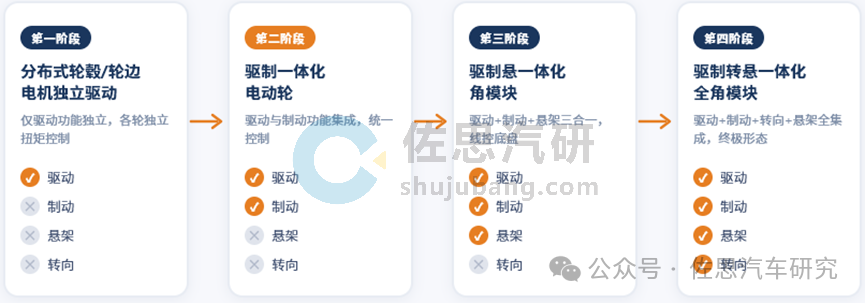
01. Distributed Drive: Corner Motors Are the Mainstream Route Corner drive and in-wheel drive are two important technical routes for distributed drive. Corner drive places the drive motor on the axle or suspension near the wheel, and the motor output is transmitted to the wheel via a reducer and half-shaft; in-wheel drive directly integrates the drive motor and reduction mechanism inside the wheel hub, with the motor rotor directly connected to the wheel, driving the wheel after deceleration via planetary gears. From the current market landscape, corner motors are the absolute mainstream. Mass-produced solutions such as BYD e4, Changan Taihang Distributed Electric Drive, Zeekr Four-Motor Distributed Electric Drive, GAC Three-Motor Four-Wheel Drive, and Xiaomi SU7 Ultra Three-Motor all adopt the corner motor architecture. 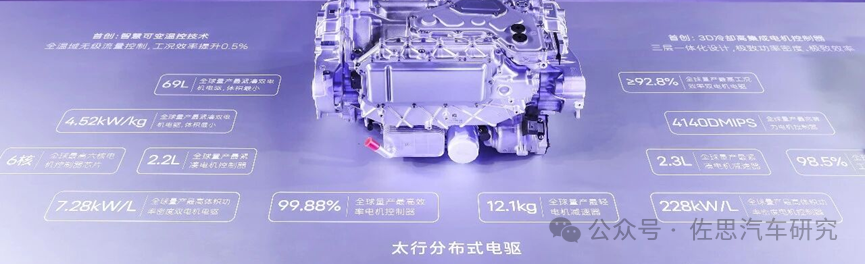
02. Integrated Drive and Braking: Three Routes Advancing in Parallel The core of integrated drive and braking is to break the architectural boundaries of the traditional "independent drive-braking control", deeply integrating the originally independent drive and braking systems in terms of mechanical structure and control logic, to achieve functional synergy, structural integration, and unified scheduling. Currently, the mainstream technical routes for integrated drive and braking mainly include the following three: Integration of drive and braking at the control level: The drive and braking units are mechanically separated, but control is centralized. This is the lightest integration route, without changing the hardware architecture. A typical case is Huawei DriveONE, which can reduce the braking distance on slippery roads by nearly 10 meters through synchronized drive and braking frequency control; Axle-end integration solution: Moving the brake from the wheel end to the inside of the electric drive axle to achieve physical integration of drive and braking. Representative cases include the Mercedes-Benz In-drive solution. This system migrates the traditional braking device from inside the wheel to the electric drive unit, integrating it with the motor, transmission, and differential in the same module. Different from the traditional brake structure of "rotating brake disc + fixed brake pad", In-drive uses a pair of stationary brake discs fixed on both sides of the drive unit, clamping a rotating double-sided brake pad connected to the drive shaft to realize the braking function. In-wheel motor wheel-end integration solution This solution integrates all power, transmission, and braking devices inside the wheel hub, representing the route with the highest integration level. Typical cases include products such as the Protean Pm18-800V solution, Schaeffler PowerWheel, Aumovio Drive-Brake Unit, Asia-Pacific in-wheel motor, and Qingshan Industry in-wheel motor. This route has the highest technical difficulty, but it is also the essential path.